In politics it has been shown that different philosophies can work. The same has been proven in baseball. In America's favorite pastime, there are those who desire to win now, and those who desire to win later. Believers in the former are usually marketable high-rollers, winning by using their unparallelled assets to simply outspend the competition. Those following the latter are usually small market teams possessing a smart front office and a revolutionary way of looking at free agents. They also keep talent in the organization by good drafting. When the Yankees reload, the Cincinnati Reds refill.
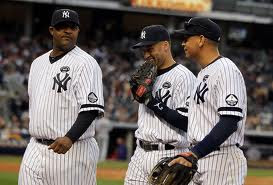
Teams with higher salaries are usually the teams with the rings. That is undeniable. As mentioned above, they can simply outspend the competition. While the strategy of going out and signing high-profile free agents is exciting, it is very difficult to keep doing. The signings have to work well, for if they do not, then the team loses and attendance sinks, therefore limiting profits and eliminating the possibility to give a competitive offer or provide a stable, winning environment. However, the few teams that use said philosophy are very good at it. The New York Yankees, Philadelphia Phillies, and Boston Red Sox built up a strong core with players they developed in-house, then reaped the benefits and using the newfound cash to buy championships. The Yankees had their "Core Four" in Derek Jeter, Mariano Rivera, Jorge Posada, and Andy Petite. They won A LOT with them. This enabled them to trade for, and later resign Alex Rodriguez to one of the largest contracts in baseball history. After first baseman Jason Giambi left in free agency, rather than using one of their developed and relatively cheap Triple-A prospects, the signed Mark Teixeira to a very large contract. A similar situation developed when catcher Jorge Posada began faltering behind the plate. Rather than use talented Jesus Montero, who was traded to the Seattle Mariners during spring training, they went out and got Russel Martin. On opening day, only three of the Yankees starters came from their farm system. A similar scenario has shown itself in Boston. Behind Theo Epstein, the Red Sox were very good at evaluating talent. They were also good at offering big contracts, as shown by their recent signings of Adrian Gonzalez and Carl Crawford. The Red Sox won the World Series in 2004, and again in 2007, and both of those teams' key players were acquired through trades and free agency. The Philadelphia Phillies are no different. They exploded on to the MLB scene in 2008 by beating the Tampa Bay Rays to win the World Series and returning the following season, albeit losing to the New York Yankees. The front office proceeded to open up the checkbook, trading for expensive but talented veterans like pitcher Roy Halladay, and signing Cliff Lee. While they may have developed players like the injury prone Chase Utley and Ryan Howard, the impact of what they have done in free agency and trades far outweighs the impact of developed players.

The other side of the spending spectrum contains winners as well. Penny-pinchers like the Tampa Bay Rays, Cincinnati Reds and, to an extent, the Texas Rangers are perennial "Next Year Is The Year" teams, as their star prospects always seem to take longer to get to the big leagues than necessary. The Rays were, and still are contenders with a very low salary. They developed talented players like third baseman Evan Longoria, and outfielders B.J. Upton and Carl Crawford, and still managed to win games, even if they were in the same divisions as the aforementioned Yankees and Red Sox. They have faith in their general managers and in their ability to draft well. These teams are often very efficient with costs and players. When players become stars on cost-effective teams, they either have become attached to the area, like Reds first baseman Joey Votto, or leave for bigger markets, like Crawford, but that is an obvious risk with prospects, as they can quickly become expensive luxuries and sign elsewhere, whereas a free agent is a known value and is signed to a longer deal that is generally more team-friendly in the long run, for a prospect's price goes up when an older free agent's goes down. The Cincinnati Reds, like the Rays, have consistently had one of the lower payrolls in Major League Baseball. They traded big stars like Ken Griffey Jr. and Adam Dunn, who was developed in the system, for prospects, to make room for players they drafted. Griffey Jr. made room for slugging outfielder Jay Bruce, who was drafted and developed in the Reds farm system. Then, Joey Votto, was drafted, signed, and resigned to be a career Cincinnati Red. On opening day, five of the nine starting players were drafted by the Reds. When these prospects become too expensive, as Bruce and pitcher Johnny Cueto might, there will be others waiting at the doorstep to step up. A similar situation unfolded in Texas, as the Rangers lost one of the most popular players in baseball, pitcher C.J Wilson to the Angels. Wilson was brought up by the Rangers, as were potential-laden players like Neftali Feliz and Elvis Andrus. Wilson's free agency was a hot topic, as he was very expensive but not necessarily worth the money he was demanding, so those who wanted to win now campaigned for a new deal, while others realized that a prospect like Feliz could fill the void without much of a drop in performance, if at all.
Different teams have different philosophies. The big spenders have to win now, and their method of acquiring players or filling needs reflects that attitude. Rather than wait for prospects, teams like the Yankees, Red Sox, and Phillies attack the free agent market with reckless abandon, while other teams like the Rays, Reds, and Rangers are more patient and fill their needs with players they drafted and nurtured. Both philosophies have a proven track record, as every team mentioned, save the Reds, though they may get there soon, has been to the World Series in the last five years, regardless of whether or not they got there with players they bought. Some teams choose to spend; others have to to maintain a steady fanbase and revenue source. Some teams choose to stick with their own players; others have to due to a lack of resources. The only question is, which do you prefer?
Images retrieved from: www.bleacherreport.com


