Sunday, February 23, 2014

Every Rose Has Its Thorn


Junior year has been a bear to say the least. A lot has changed since my last few posts, granted they are growing even fewer in number and further in between. I've been named the Sports Editor of my school newspaper, gotten a 220 on the PSAT, decided to go into cardiology, won awards for outstanding mock trial work as an attorney, and begun to question my formerly staunch libertarianism. That being said, I am still a passionate sports fan, and though my time here grows less and less, I appreciate whoever still reads these posts. Here is a persuasive essay--forced to be in the Rogerian format--I have written for my English III class, with a few extra paragraphs split up for ease of reading, which will be followed by an opposing view by the end of the week.

The man I marvel at is the one that’s in there day after day, and night after night, and still puts figures on the board.  I’m talking about Pete Rose.” 
--Sparky Anderson

    On August 24, 1989, then-MLB commissioner Bart Giamatti delivered an edict that would forever change the face of professional baseball: Pete Rose, manager of the Cincinnati Reds, was forever banned from the game he loved. Baseball’s hit king had been swiftly and unceremoniously dethroned. Gone were the cheers, the certain Hall of Fame induction, and his career, all, of course, for betting on his team to win the games in which it played. Though this was a clear violation of the written rules all players and managers must abide by—as supporters of the punishment often cite---a lifetime ban, especially in light of recent developments, is quite clearly too severe a penalty. The man that played the most games in league history, collected the most hits, a 1900s All-Century selection, two Gold Glove awards, three batting titles, and an MVP award, deserves better. It is time for the ban to be lifted and to release Pete Rose from his prison without bars.  

     Though Rose admittedly did break rules, it is important to note that his gambling never actually affected the outcomes of games, which was the intent behind the rule itself. The stated goal of a manager is, quite obviously, to win games. And considering the fact that Rose almost exclusively bet on the Reds, always to win, he was only providing himself another incentive to do so. There were not instances of point-shaving, spread covering, or game-throwing—such were insults to the man’s competitiveness. His goal was to win every game, every season. Further, the punishments for actually affecting games by means of PEDs, scuffing baseballs, or impeding runners—the largest of which being a 162 game ban held by Alex Rodriguez—pale in comparison to Rose’s which obviously did not affect his managing as it only further incentivized him to perform at  a high level.  "I bet on my team to win every night because I love my team, I believe in my team," Rose said in an interview with ESPN. "I did everything in my power every night to win that game.” Is that not the true meaning of competitive baseball?

     The man has been punished for supporting his team, while others have comparatively walked away unscathed for deliberately affecting games, and many have walked right into the place Rose will never be: The Hall of Fame. The most obvious symbol of Rose’s punishment, the Hall of Fame markets itself as a testament to the history of Major League Baseball. Outside of a performance-based election by either the Veteran’s Committee or the Baseball Writers’ Association of America, there are no real standards for entry. Yet, interestingly, a large majority of the proponents of Rose’s suspension act as though it is a cathedral and that he is stuck at the gates. He is, many claim, morally unfit for the honor. By violating the rules of the game, he knowingly sacrificed his chance at immortality. However, many other players of dubious character have been allowed on the ballot and have actually been enshrined in Cooperstown. 

     To name a few: Ty Cobb was a racist, Don Sutton doctored baseballs, Willie Mays and Hank Aaron used amphetamines, and John McGraw even tripped baserunners while the umpires were distracted. Goose Gossage even wrote a book about his illegal escapades. Further, the Hall already profits from his contributions to the game. There are over twenty pieces of Rose memorabilia in the Hall of Fame. Why they cannot enshrine the man who gave those pieces meaning is beyond comprehension. If the Hall truly serves to memorialize the history of the game, “Charlie Hustle,” a man who has admitted his wrongdoing and repented, deserves to be a part of it. 

     The most obvious contribution Pete Rose made to baseball was his superlative work ethic. Though some believe that by gambling he violated the central tenet of the game, that he sold baseball’s soul for personal gain, it is quite clear that he actually supported it. Rose embodied the ideal competitor. He ran to first base on walks, slid headfirst into bases, and took the competitive spirit and fire the game cherishes to an entirely new level. He never took a play off. He even took an exhibition game—the All-Star game—and turned it into a lesson on hustle, separating catcher Ray Fosse’s left shoulder in a successful effort to win the game for the National League. Winning was all that mattered. And though Rose was not the most gifted hitter, nor the best fielder, nor even the best athlete, he was the best hustler—the central dogma of the sport. Enshrining Rose, or at least lifting his ban, would represent a symbolic return to the fundamental values—grit, competiveness, hustle, and a “win at all costs” attitude—of the sport that supporters of the ban say he somehow violated. It is quite obvious that a league without Rose is a league without its soul. 

     Pete Rose is the victim of an unfortunate double standard. “…to be honest with you, I picked the wrong vice. I should have picked alcohol. I should have picked drugs or I should have picked up beating up my wife or girlfriend because if you do those three, you get a second chance,” he said in an interview. Though tactless, he might be right. Though some believe Rose deserves a ban for violating the rules of the game, such a view is misguided. By supposedly degrading the integrity of the game, Rose brought forth one of its greatest attributes—will to win honestly. He never threw a game. He never artificially boosted his performance with PEDs like Sammy Sosa, Roger Clemens, Mark McGwire, or Barry Bonds, all of whom are still in good standing with Major League Baseball. He never deliberately or directly affected the outcomes of games. All he did was be the 28th greatest hitter in league history. Should he have done any of these despicable actions in place of betting on his own team, ironically, he would have a place in Cooperstown by now.  And that has to change. Let the king return to his throne. 
 Pete Rose runs over Ray Fosse

Images retrieved from: realclearsports.com, intoon.com, gifsoup.com, and
latcrossword.blogspot.com

Wednesday, December 18, 2013

First Post in a Long Time

Hello, I know it's been a while since my last real post. I am actually working on one, though, so there's that. This has been a strange time for me--I got a 220 on the PSAT (75 CR, 78MTH, 67WS), got into the all of the AP classes I applied to, and am the editor of my school newspaper's sports section, all while dealing with a potential ADD diagnosis and some emotional strains due to some low grades and familial struggles. Nonetheless, this school project fit the bill as something I would post (read: have a strong opinion on). The first part is my stance, the second is an opinion in light of said stance. Without further ado...

_________________________________________________________________________________
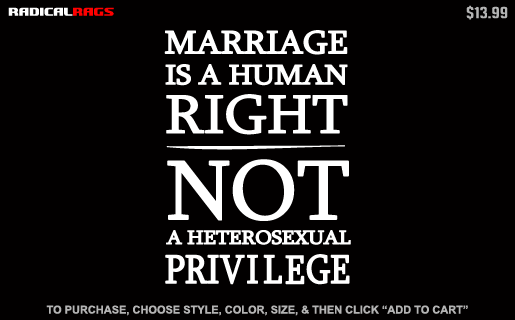
     Throughout mankind’s history, discrimination has often been the norm, not the outlier. In the United States alone, and without going into great detail, the hate has shifted from Native Americans to African-Americans to Catholics, to Jews and now more currently, to homosexuals in addition to all the others. In short, the claim that the nation that prides itself upon liberty and equality has eliminated discrimination within its government is inherently false. Homosexuals have been and are continuing to be denied basic human rights as a consequence of codified bigotry. In an egregious violation of moral and constitutional law, the U.S government has stripped individuals of the right to marry, artificially labeled them as subhumans, and prevented them from participating in aspects of life for reasons only based in their sexual orientation.

     Homosexuals have been unable to marry for centuries. Homosexuality was seen as an unnatural abomination, and as such was outlawed. Yet, times and laws change. The ones regulating same-sex marriage, however, largely did not. The Defense of Marriage Act, signed into law by President Bill Clinton in 1996, prohibited marriage between members of the same gender and defined marriage as a union solely between one man and one woman. (GovTrack, 3) As of 2012, homosexuals unfortunate enough to be in one of thirty-seven states are denied 1,138 additional benefits and responsibilities ranging from inheritance issues to a lack of spousal protection in court cases. (Human Rights Campaign, 1) Furthermore, the recent ruling of the United States Supreme Court overruling certain parts of the aforementioned Defense of Marriage Act only applies in the thirteen states that actually have legalized same-sex marriage. As such, many couples are left with little more than a written acknowledgement of their commitment that often does not translate across state borders—a civil union.

     Beyond basic legal rights like marriage and tax issues, homosexuals find themselves victims of the system in daily life as well. Homosexual males are almost entirely banned from donating blood. (NBC News Health, 1). Due to an AIDS outbreak in the 1980s, any homosexual male that had engaged in sexual intercourse with a member of his own sex was forever banned from donating blood, even if he was not infected with any sexually transmitted disease. Further, in certain states that do not allow unmarried couples to adopt, such as Nebraska, Utah, and Ohio, homosexuals are forever banned from adopting a child and even face undue discrimination in the adoption process in states like Mississippi. (Wong, 1) Though popular opinion has changed dramatically over the last decade, particularly men, are shown undue scrutiny based upon unflattering stereotypes. They also have to deal with daily slurs and homophobic actions. Words and phrases like “faggot” or “no homo” may seem humorous to some, when in reality, they are far from it. Yet, despite substantial media coverage and the obvious presence of homophobia, only around two-thirds of states include sexual orientation in hate crime legislation.  (Shively, 10)

     The unreasonable prejudice extends to the areas that are supposed to preach tolerance and acceptance—churches. People of faith generally misunderstand homosexuality, and as such refuse basic rights and see them as subhuman. Though churches are well within their right to whom they give their ceremonies, many followers misunderstand their faith’s teachings. As New Jersey Governor Chris Christie (R) stated regarding his position on homosexuality, "My religion says it's a sin,” expressing a popular misconception among Catholics. (On the Issues, 1) The Church’s actual teaching is essentially that homosexuals are no more prone to sin or are more sinful than heterosexuals. Homosexuals can take full part in their faith.( United States Conference of Catholic Bishops, 1) Being a homosexual is not a sin; rather, it could actually be a call to holiness, as some believe was mentioned in Matthew 19:12. Sex outside of marriage and sex incapable of producing a child, however, categories in which all homosexual sexual contact falls under, are inherently sinful. In short, acting upon homosexual attractions is sinful. In an asexual context, having them, however, is not. However, many groups, particularly the infamous Westboro Baptist Church, protest against immoral “choices,” when, in actuality, homosexuality is not a choice at all. Such groups reject reality in order to create their own. “Pray the gay away,” is far worse than and hardly comparable to “Born this way.”

     Just as people of faith unfortunately misinterpret the tolerant words of Jesus Christ, many citizens fail to understand the United States Constitution—the gospel of American law. The Defense of Marriage Act was a blatant overreach of boundaries as the Constitution never gave any legislative body the authority to regulate primarily religious institutions. Further, such regulation was never necessary to a degree similar to that of roads, federal banks, or public schools, and certainly never proper in a legal sense to warrant wholesale restrictions upon the institution. However, mountains of red tape and webs of tax law have made a “hands-off” approach impossible. Yet, a simple solution can be found—the fourteenth amendment, which guarantees equal protection under the law. As it stands, the federal government does not afford equal protection to homosexuals in multiple ways, most obviously in the form of denying spousal protection in legal trials. Partners must take the stand against each other if called. (Ghianni, 1) Here, there is no protection under the law at all. Further, there is a more tangible burden that applies only to homosexual couples—the financial one. Homosexuals are denied marriage tax deductions and Social Security survivor benefits as they cannot get married. (Human Rights Campaign, 1-3)There is a financial penalty for being born different.


     Even after a brief examination of the facts, it is clear that the United States of America discriminates against homosexuals. It denies basic rights in marriage, provides a legal consequence-free environment for such discrimination, and treats them as sub-humans by refusing to let them engage in basic civil functions like blood donation. All because they were born different. They loved someone else. Congress cannot regulate human attraction. It should not even try. It can however, protect its constituents and afford them the rights and protections given to them by the Constitution. 
_________________________________________________________________________________
     I believe that the Church can teach it whatever feels best fits its teachings. Catholic tradition holds that the Holy Family was composed of a heterosexual couple of a man and a woman, and a son—Jesus Christ. A ban on homosexual marriage is in line with its teachings due to its endorsement of sex and marriage as primarily child-bearing unions, though it may certainly be against the tolerant message of Jesus’ message. Further, Jesus never really stated an opinion on the definition of marriage, who can take part in it, and why he believed such things. Further, the Bible contains few references to homosexuals beyond those of Sodom and Gomorrah. Looking through a strictly biological lens, it is clear that heterosexuality is the more advantageous option for the human race—the “blueprint” has been given to humanity. In a Roman point of view, the Church had to side with heterosexuality because of that fact.

     I feel that the Church has done a very poor job of educating its priests and the laity, because many misunderstand its teachings, as shown through the prior Christie quote. At my church, I have overheard a few discussions and read through the parish book of intentions (a spiral notebook people can scrawl intentions in for Mass) enough times to know that many parishioners lack a basic understanding of what it actually means to be a homosexual. They base opinions in stereotypes they find on TV, on the radio, or on the internet and discuss ways to “fix” “erstwhile” children. It is rather disappointing.

     On a purely political level, I would support lifting the ban on same-sex marriage. I find the issue to be very similar to the previous ban upon interracial marriage, which was lifted after a Supreme Court ruling. People cannot change their sexual orientation just as they cannot change to a significant degree the color of their skin. Why restrict social freedoms—marriage or otherwise-- for something one cannot change? I respect the Catholic Church’s position, yet find it necessary to federally respect same-sex marriages and other rights many religious groups (perhaps mistakenly) do not. Perhaps the reader can gather I have a somewhat strict definition of the Constitution—I, along with many others,--find Congress has made a law that directly violates the right to equal protection under the law it affords, one that also restricts the natural rights Thomas Jefferson promises in the Declaration of Independence—the pursuit of happiness.

     Though I am not a homosexual, I find it tremendously shallow that people find love to be based upon what kind of genitals a person happens to possess rather than his or her mind, soul, or being. That being said, I feel as though the Catholic Church, of which I am a devoted follower, has every right to control, defend, or even radically alter its position on this important topic. The government, however, does not. Homosexuals are citizens too. Rights are inalienable, regardless of who has them.

All images are used for non-commercial purposes and will be taken down if such action is requested.


Sunday, November 3, 2013

1984 Essay: A Loss of Colour

     In 1783, Noah Webster broke what was seen as the final cultural bond between the newly created United States of America and Great Britain—the language. While the accuracy of the statement is dubious at best, the sentiment is clear. In rewriting and re-spelling large parts of English, Webster helped shape a nation. No longer did the nations share a government, why, therefore, should they share words? By subtly changing words supported by an “oppressive” London regime, he created a newfound American identity. Unfortunately, the same actions could be used for decidedly less benevolent reasons. In George Orwell’s 1984, entire committees would be given Webster’s task, amending his work to manipulate the masses to form Newspeak. By crafting slogans like “War is Peace,” “Freedom is Slavery,” and “Ignorance is Strength,” Syme and his Party counterparts could stop rebellions, start wars, and force unyielding loyalty to Big Brother. Unfortunately, however, Newspeak is not entirely fictional. By coining new phrases and crafting an entirely new lexicon to placate the masses, governments across the world are using Newspeak in all parts of life, bringing 1984 into 2013.

      Before delving into the modern usage of Newspeak, it would be beneficial to first understand the quintessential foundation of the language: the Party slogans. “War is Peace” is the first part of the Party’s infamous ode to doublethink. By equating two seemingly conflicting views, the Party obviously seeks to confuse its base. “Peace” is often defined as a lack of war, but also can be seen as a period of normalcy. Because war in 1984 is no longer an occasional eruption of extreme violence but a constant fact of life, dedicated Party members and the proletariat find no actual conflict or irony in the phrase. Though the entirety of Oceania has never experienced “peace,” they seem to find it in, of all things, war. They simply do not know the definition of the word. Or, more likely, it has been so grossly distorted they cannot tell a difference between the two. Citizens do not accept the meaningless platitudes given to them because they agree; they accept them because they do not know or understand how to do anything else. True peace would not be peace at all. It would be an entirely new feeling. They have never understood peace; only Big Brother has. He knows all.

     Such unknowing leads nicely into another tenet of the party, “Ignorance is Strength.” In Oceania, what the constituents do not know cannot truly “hurt” them. They live a “painless” existence. By not comprehending certain concepts, namely rebellion, peace, or freedom, the people find their greatest strength: their ignorance. They are good, faithful party members to their deaths. Big Brother, the followers know, is the only true source of knowledge and power. He sees all, knows all, and hears all. By remaining faithful, they can please their god. By remaining ignorant they can be strong for their fellow Party member. In a similar fashion to peace in the prior paragraph, members have never truly felt intellectual strength. Limiting the number of words and by extension increasing the ignorance of the people makes them stronger—they will be better equipped to ward off the evils of freedom and self-rule—and they are forever grateful to their masters for making it so. Such mindsets create a conscious loyalty. “But…” as said in the novel, “language can also corrupt thought,” creating an unsettling, unconscious loyalty that comes with ignorance: the failure to realize that great atrocities are being committed, curtailing any chance of social change.

     The third and final plank of the Party slogan is “Freedom is Slavery.” The masses have never felt empowered except in ignorance. Nobody has control of his own destiny. Yet, somehow, they do have control. Everyone voluntarily works for Big Brother, some out of ignorance and blind loyalty, the others out of fear—another way the Party forces fealty—and in that fact, the population has freedom. They choose to work for the government. They are slaves not only to the state, but to themselves. And in that, they are set free only because there is no freedom to contrast their slavery. For example, the personal and loving bonds in a sexually-intimate relationship have now been stripped to, as Winston’s wife says, “doing their duty to the Party.” To their own ignorance, they are slaves; yet, they have been set free from any form of “evil.” No longer are they slaves to nature, to feelings, or even to themselves. In that, slavery to Big Brother is the ultimate expression of freedom. The elimination of “I” leads to freedom. However, the inevitable elimination of the word “freedom” from Newspeak leads to numerous questions. As Syme, a key contributor to Newspeak states:

 “How could you have a slogan like "freedom is slavery" when the concept of freedom has been abolished? The whole climate of thought will be different. In fact there will be no thought, as we understand it now.”

     The three slogans of the party are certainly far from those of any modern government, yet, the premise of each is very similar—fostering ideals to an accepting nation creates loyalty. It is not necessarily a bad thing, but it certainly has frightening implications. Newspeak or its manipulation of words, it seems, could simply be seen as an extreme form of “political correctness.” “War is Peace” can be found in any nightly news segment—“collateral damage” used to refer to construction demolition. Now, however, the term serves to belittle the deaths of individuals with hopes, dreams, and aspirations lost as a consequence of war. Supposedly, U.S. waged war to prevent war in Iraq and Iran—a “crusade.” U.S. citizens cannot necessarily take “facts” to be true either. Ignorance to mismanaged campaign funds or certain website rollouts makes their lives in the poll booths easier—they are stronger. Laws are necessary to society. They are designed to protect and propagate natural rights. Yet, do they not create some form of servitude? Slavery, it seems, does lead to freedom.


     In short, Noah Webster’s dictionary has had a profound impact on society. Aided by a new set of grammatical mechanics and spellings, the United States eventually developed a culture quite different than that of Britain. Yet, his experience also indicated the true power a jumble of letters can have. By limiting the amount of words and “narrowing the range of thought,” the Party effectively pacified the masses, forcing a totalitarian monster upon the unsuspecting victims. The power of words is unquestionable. Yet, the practice is not limited to fiction. Ignorance to that fact, however, can be deadly, not life-giving. War will never be Peace. Freedom will never be Slavery. Ignorance will never be Strength. And nothing, no government, committee, dictionary, or lack of experience, will ever change that. 

Tuesday, September 3, 2013

Fear

     I was watching a particularly interesting 60 Minutes special last Sunday when I realized the all-encompassing power of the web, while, ironically, trying to fix my computer to get back on to it. I learned that facial recognition software, at least according to the documentary, had advanced so much in the last decade that business only needed a clear view of one’s face for about three seconds to know where they lived, what kind of beverages, restaurants, foods, or even what movies someone “liked,” on Facebook—all for “market research.” From the same information, any determined individual could decipher anyone’s IP and by extension, their location. My digital world suddenly changing from a land of utopian commerce to one of Orwellian scope and nature, I began to question my online identity—my columns, comments, and social media accounts—and whether or not my profiles were defining me, and not the other way around. 

     I believe that social media is progressively making us less human and more of a number on a screen—a photo, a name, and rarely, if ever, anything more. I’m a purist. I want human interaction rather than mere connection that comes with websites like Facebook, Twitter, or Instagram. As an INTJ/ENTJ, however, I stumble in conversation. I’m awkward. I shrink under pressure. I find the sterile confines of the web and its endless possibilities intoxicating. Social media gives people like me an opportunity to superscore my Q rating and be what I want to be, not what I necessarily am. That being said, I find my Facebook page to be a fair reflection of my actual existence. On my wall, I posture myself as an intellectual, something I strive to be in my real life, and, despite my talkative nature, I rarely post unless I need to. My family always has an opinion on my statuses, or lack thereof. They seem surprised that I don’t post more frequently than I actually do, again due to my strong opinions on certain topics. To them, my profile appears a tad strange, though they seem to think I am perpetually happy due to the fact that I am smiling in all of my pictures from my recent trip through Europe, which certainly isn’t true. However, what I post isn’t necessarily what defines me.

     I think one could learn as much about a person from what websites they use as what they actually post on them. I use Facebook because it lends itself to a clean, user-friendly experience, which might be the reason I haven’t jumped to Twitter just yet. I prefer a simple, no-frills design, which is why I like the Drudge Report, ESPN, and Grantland. Each site lays out its information efficiently—there’s no wasted space—and doesn’t toy around with gimmicks, a type of existence I hope to someday embody—informative, to the point, and accessible. I refuse to use Windows 8 or a Windows phone because both represent the opposite. They’re clunky, inefficient, and misleading. On a more personal level, I want my friends to have the same traits as my websites—another way my digital persona, or rather, the opinions within, reflect my real self. Nobody needs to feign wealth or relevancy by wearing a sweater in August, even if it is from Vineyard Vines, something which I have actually seen happens this year. It’s just not sensible, nor simple, and a seemingly intentional attempt to be more “special” than one really is. Anyone can be “relevant” with designer clothes or, in the case of a website, a slick design, but only the greats get by on their content. Simplicity, after all, is the ultimate sophistication.

     Evan Ratliff’s attempt to vanish showed the impact technology has had on the world, but also indicated a shift in digital habits. People originally saw computers as tools and social media as something best left to the youth. Now, however, the digital world has singlehandedly brought lolcats, bitcoins, and “trolling” into real life. More and more frequently I see people using their electronic devices to compensate for a lack of human interaction. Over the summer, I walked through the Royal Holloway, University of London to only find all the “interaction areas” filled with college students who were staring into their phones rather than using the space as it was intended to be—Sherry Turkle’s “Flight from Conversation” is officially an international movement. Up until the 20th century, people would remove their hats upon meeting someone. In today’s world, they would remove their headphones. As I’m typing, my brother is playing the MMO game Minecraft to work with his friends on a building project rather than doing his homework or actually talking with said friends.


     My digital persona is as much a part of my life as my life is part of my digital persona. I made friends online. I also made more than a few enemies. The Internet’s expansion is inevitable, as is the death of traditional privacy. It seems both the digital and physical worlds are finally beginning to eclipse, and each of us has the privilege (?)  of watching it happen in real time. But as we all watch, we should occasionally take time to realize where we are all going, and look up from our devices to avoid the pitfalls not shown on the screen. 

Wednesday, May 22, 2013

Separate But Equal?


      The boys of summer are back, my friends. As our school year slowly draws to a close, the baseball season is only beginning. However, when veritable Reds punching bags, the lowly Houston Astros, tragically moved to the AL West, a monumental shift in baseball occurred--interleague play is now an everyday event. While some fans, and certainly all franchise owners, may relish the fact that their hometown teams get to play clubs like the Yankees or the Red Sox on a daily basis, many people see a glaring inefficiency in this “opportunity”: the discrepancies regarding the usage of a DH, or designated hitter, to bat for a team’s pitcher-the AL uses it, the NL does not--will always put one team at a significant tactical disadvantage depending upon where the game is played. While some may praise the National League’s stance on this issue for keeping true to “tradition,” and for “protecting the “complete player,” many, including the author, have called for the universal institution of the designated hitter in major league baseball.

     Given the aforementioned fact that interleague play is now an everyday occurrence, Major League Baseball’s policy of “Separate but Equal,” in regards to keeping the DH out of the NL while supposedly keeping a level of play comparable to that of the AL,  no longer applies. It is time for change. This doesn’t just hurt the NL, however. As mentioned above, one team, be it AL or NL, is always being put at a tactical disadvantage in every competition they play in-NL teams do not have a consistent DH to use like all AL teams do, and AL teams do not have a large enough sample size to weigh a given player’s talent or lack thereof in the field against his offensive capabilities in order to set a lineup, like all NL teams do. Universally instituting the DH would instantly level the playing field and add much needed punch to National League lineups and simplify the process for managers and front offices across the league, who will struggle deciding whether or not to keep a fulltime DH on 25 man roster although they may not be used every day.

     Furthermore, the DH rule can also be seen as a safety rule, both from a financial aspect and a physical health aspect as well. Let’s use a hypothetical: Dusty Baker finally puts Aroldis Chapman into the starting rotation, and in his first at bat of the season, he gets plunked in the head and is concussed, leaving his career in jeopardy-a $30,000,000 investment wasted. This actually has happened before--Chien Ming Wang, a former Yankees pitcher, fell victim to a similar situation running the bases, he blamed lack of experience doing so as the cause, against an NL team and his career was essentially ended. Because of the inherent risk of batting, GMs need the financial security that comes with a DH rule so that their expensive investments in pitchers aren't cut short for any reason besides a general lack of talent. Also, the newfound ability to develop prospects at the then universal position, DH, would revitalize the league’s trade market High schools use a DH to make games more competitive and safe, so do colleges, why can’t the MLB?

       From a mathematical stand point, adding a DH would create roughly 40 additional runs to add to any team’s offensive output, translating to more wins and higher scoring games-a formula for baseball parity and higher attendance, translating to higher revenues and better teams. It is interesting to note that an overwhelming majority of World Series winners and attendance leaders since the DH was created in 1973 have hailed from the American League, which traditionally uses the DH every game, perhaps due to higher scoring games generating more fan interest and therefore more revenue to spend on players in the form of ticket sales. In regards to jersey sales-the DH provides a10th “starter” to capitalize upon, increasing sales by default. In comparison, the NL’s inherent lack of marketable bench players and the limit to nine “starters” per lineup effectively caps the amount revenue NL teams can receive and spend on players.

     There always comes a time when tradition must give way to progress. For baseball, that time has finally come. Gone are the days of the “complete” player-pitchers are paid and scouted for their ability to throw the ball, not hit it, after all and there has never been a truly complete player who could hit and pitch in baseball history besides one George Herman Ruth. Pitchers’ legacies are created on the mound, not on the batter’s box, and hitters are judged at the plate, not in the field- so why try to force something upon fans, the myth of the complete player, that isn't true? Why force aging legends out of baseball, when they can extend their careers like Frank Thomas did? Let’s make the game great again. Long live baseball. Long live the designated hitter.